
She Did That
Taylor Swift, Madison Square Garden, and the female power people still cannot bring themselves to name.

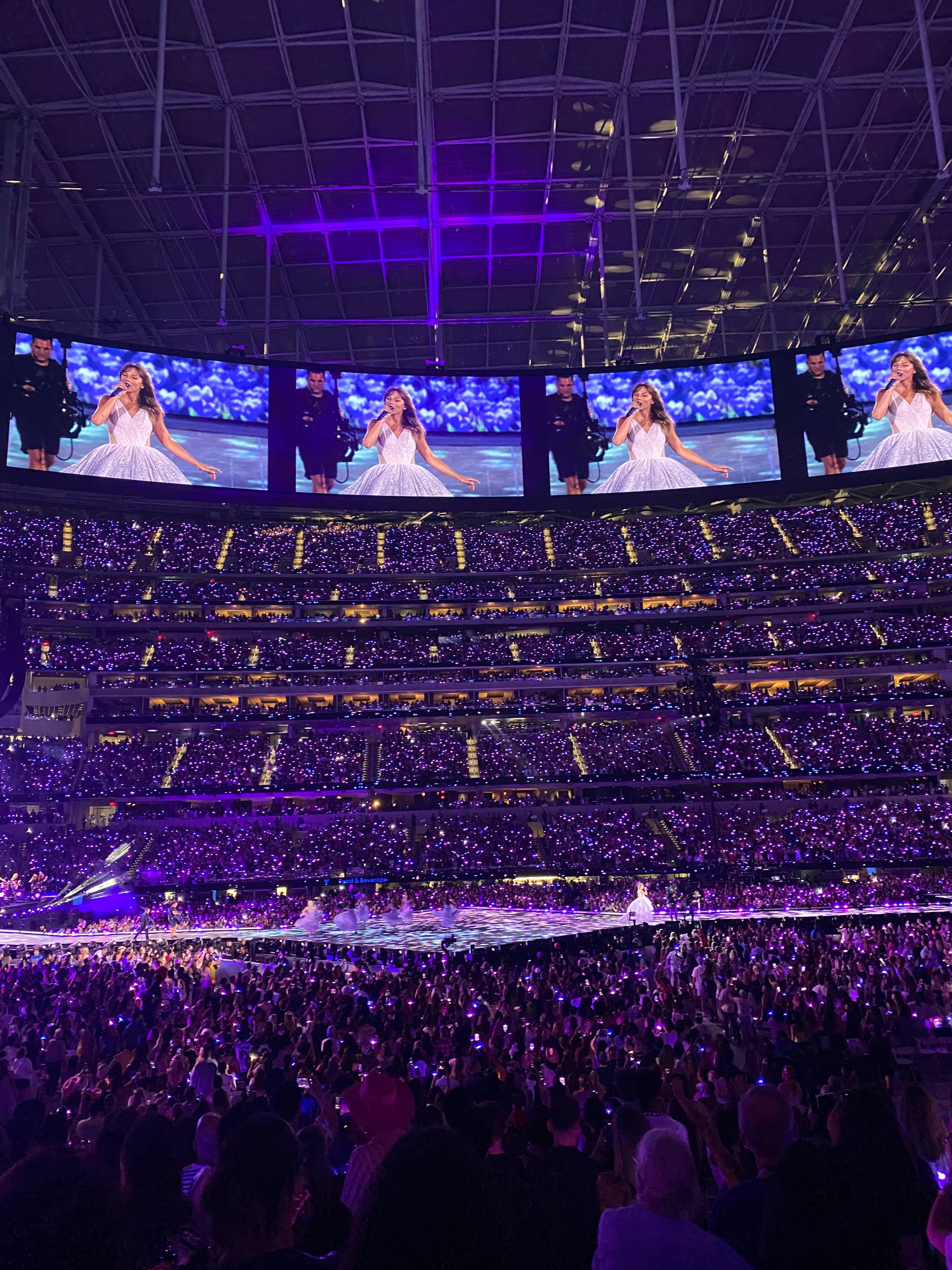
Taylor Swift at SoFi Stadium in Los Angeles on August 3rd, 2023, during the filming of The Eras Tour concert film.
On July 3rd, I walked two avenues over to Madison Square Garden in Midtown Manhattan because, like any lifelong journalist, I wanted to witness a historic cultural moment firsthand and share what I saw.
It was brutally hot, the kind of Manhattan heat that makes every cab, barricade, trash bag, police officer, tourist, and irritated pedestrian feel twice as vivid. The streets around Madison Square Garden were not behaving like ordinary streets.
Stretches of Seventh and Eighth Avenue, which rarely close, were completely blocked off and surrounded by barricades and NYPD officers. Cross streets surrounding the arena had shifted into a strange combination of security operation, pilgrimage site, media ecosystem, and civic inconvenience. People were gathering, filming, complaining, speculating, sweating, waiting, and looking around at one another as if the city itself had become part of the event.
To me, this was never just about Taylor Swift and Travis Kelce getting married at MSG. What struck me was the physical fact that a woman had become powerful enough that America’s largest city had to reorganize itself around her.
Very few people can make New York City do that. A president can. People who arrive inside offices and institutions so powerful that the city begins responding before the individual even appears can. A president can make Manhattan stop, but a president brings the state with him. The title does much of the work. The security apparatus, motorcade, sealed-off blocks, and the air of national importance all belong to the office before they belong to the person.
What I saw outside Madison Square Garden felt different. There was no elected mandate, inherited throne, constitutional authority, or formal state power. There was an artist whose private life had become public gravity because millions of people had attached meaning to the work she spent decades making from the raw material of her own life.
In all my years living in New York, and in all my years going to Madison Square Garden for major concerts, Knicks and Rangers games, college basketball championships, and sold-out events, I have never seen the area around Seventh and Eighth feel quite like that. I am talking about major Manhattan avenues, surrounding blocks, police presence, managed access, barricades, and the unmistakable feeling that something larger than a normal event was moving through the city.
But before the wedding even began, people were trying to shrink it.
I posted a short video from outside the venue on TikTok and captioned it: “POV: The middle of Manhattan shut down for a woman. Let that sink in.”
The video quickly went viral, and within hours, the comment section had written the thesis for me. It became clear immediately that many people don’t just fear or hate powerful women. They hate what female power reveals about them.
Several people understood the point. Some were happy for her. Others could feel the scale of it. But many went straight to minimization: the streets are always closed for events, Midtown was not really shut down, it was only a few blocks, this happens all the time, it was just money, just security, just traffic, just another rich person inconveniencing everyone else.
Suddenly, a woman’s cultural power had to stand trial for zoning, taxes, billionaires, philanthropy, tackiness, and whether everyone had performed the appropriate level of moral discomfort before admitting that something extraordinary had happened.
It’s as if the cultural meaning of the moment depended on winning a zoning argument with strangers who were never going to let the image remain intact.
But anyone who has actually lived in New York and fought their way through the chaos around Madison Square Garden on a concert night, a Knicks night, a championship night, or a sold-out everything night, knows the difference between ordinary congestion and a city visibly reorganizing around a private event.
That difference was the point.
The nitpicking was not evidence that nothing had happened, but that people could not bear what had happened to mean anything. They wanted to talk about blocks because they did not want to talk about power. They wanted to reduce it to traffic because traffic feels safer than admitting what was right in front of us: a woman had become so culturally powerful that New York City had to move around her.
Of course, money is part of the story. Security, privacy, and access all cost money. Coordination at that scale requires infrastructure, protection, influence, permits, labor, and people paid to make impossible things look orderly. I am not interested in pretending money was not part of the machinery.
But money and meaning are not the same thing.
Money can buy a hotel floor, a private entrance, a guarded door, a barricade, a production schedule, a police detail, and enough handlers to make ordinary movement nearly impossible. Money can close streets and purchase venues, privacy, and distance.
Money cannot, by itself, make major media outlets descend and strangers stand outside in punishing heat just to be near the atmosphere of someone else’s life. It cannot make people feel personally implicated in a lyric, a dress, a heartbreak, a silence, a reinvention, or a wedding. It cannot turn a woman’s private joy into civic theater. It cannot make people who insist they do not care spend their afternoon arguing about whether her power is real.
There are many billionaires. Most of them could seal off an entrance, hire guards, reroute a block, and still fail to make anyone feel anything. They could create disruption without creating mythology. They could command service without commanding devotion. They could move through public space with every available symbol of importance and still leave no emotional story behind.
Taylor Swift’s power is not interesting simply because she has money, but because of what the money grew from. She became one of the most powerful people in the world by writing and performing songs about her own life.
That sentence sounds almost too simple until you let the scale of it land. For decades, she has written about girlhood, humiliation, longing, betrayal, revenge, reinvention, fantasy, friendship, grief, public shame, private hope, and the ongoing labor of becoming a woman in full view of the world. She took the material women are so often mocked for caring about and turned it into a body of work that millions of people use to understand their own lives.
Her diary became architecture. Feeling became empire. Being affected became intellectual property.
That, I think, is the part people still cannot stand. As women, we are told, directly and indirectly, that our emotional lives are excessive, our heartbreaks are silly, our anger is unattractive, our ambition is suspicious, our girlhood is embarrassing, our desire is unserious unless someone can make it useful, sexy, inspirational, or harmless.
Then one woman took all of it and built a world large enough for stadiums, cities, economies, governments, hotels, airlines, fathers, daughters, critics, fans, enemies, and casual observers to organize themselves around it.
I saw extraordinary performers during the Eras Tour years. Bruce Springsteen. Sting. Pink Floyd. Katy Perry. John Legend. Pink. Norah Jones. Artists with history, mastery, stamina, and songs that shaped entire generations. Their concerts were excellent and moving in their own right.
Still, nothing altered me the way the Eras Tour did.
That is not an insult to anyone else. It is the difference between watching a brilliant show and feeling, for a few hours, as if you had stepped inside a world someone built. A world you never wanted to leave because it felt so loving, so real, so true.
That emotional intimacy is the engine. Not the ticket price, private jets, boyfriend-now-husband, billionaire status, or even the spectacle. The engine is the feeling that a woman sang so accurately to parts of your life before you had language for them yourself.
That is why people project so much onto her. That is why they defend her, resent her, study her, imitate her, diminish her, gather for her, mock her, and insist they do not care while spending their afternoon trying to correct a stranger’s interpretation of her power. She has become a container for people’s own relationships to femininity, success, money, ambition, longing, visibility, devotion, and taste.
Because she is a woman, every part of that power gets interrogated.
When men become powerful, people recognize the shape of it. They may hate it, envy it, challenge it, or critique it, but they understand the billionaire, the founder, the mogul, the owner, the kingmaker, the man no one wants to offend. They do not need to gather in a committee to decide whether his influence has influence.
A powerful man is allowed to simply be powerful.
A powerful woman is cross-examined.
Did she really earn it? Is she actually talented? Is she overrated? Is she greedy? Is she fake? Is she calculating? Is she still relatable? Is she allowed to be rich? Is she allowed to be beloved? Is she allowed to be feminine and commanding, romantic and strategic, happy and still taken seriously? Is she allowed to become so large that the old language fails?
The comments underneath my video answered that question before they meant to.
People saw a woman’s power made physically visible and immediately tried to make it less mysterious. They reached for money because money is easier to understand than devotion. They reached for billionaire men because male wealth is a familiar altar. They reached for Travis because attaching a woman to a man is still one of the fastest ways to make her feel less dangerous.
That reflex is old, and painfully boring.
A woman may be beautiful, but not commanding. Loved, but not worshiped. Successful, but not too successful. Rich, but not empire-level rich. Admired, but not world-moving. Celebrated, but only in small, manageable doses.
The old story says a woman can be the muse, but not the machine. She can inspire greatness, but she cannot be greatness. She can stand beside the man, behind the man, near the man, under the man, because of the man.
When she becomes the reason the crowd gathers, streets close, institutions prepare, and critics spiral, something in the culture starts searching for a correction.
That is why “it’s just money” was never a neutral observation. It was an attempt to make the phenomenon legible inside a framework people already understand.
Money is power, yes. No serious person denies that. But a woman artist becoming so symbolically powerful that strangers gather, cities shift, police mobilize, media watches, fans decode, critics complain, and comment sections reveal the ancient discomfort people still have with female sovereignty is not the same thing as a billionaire buying convenience and safety.
A corporate titan moving through the world with financial force is ordinary. Male wealth bending systems is ordinary. Male dominance being treated as inevitable is ordinary.
A woman artist becoming so powerful that the city bends around her tells a different story.
For some people, that story is thrilling. For others, it is intolerable.
What I saw in New York was not morally pure, beyond critique, or immune from questions about money, policing, privilege, public space, or celebrity excess. A thing can be complicated and still be extraordinary. A thing can deserve scrutiny and still carry symbolic force. A thing can be expensive, excessive, and imperfect while still revealing something culturally important about what the world cannot bear to see in a woman.
A woman with this much power is a beautiful thing.
Not because power is automatically virtuous, fame deserves worship, or wealth should be romanticized. But because there is something historically significant about watching a woman become too large for the old language.
That was what people were arguing with.
Not traffic. Not taste. Not whether these streets are often restricted. Not whether billionaires get special treatment. Those were the safer, available arguments that made it possible to stay literal in the presence of something symbolic.
They were arguing about traffic because they could not argue with power.
That is what I keep coming back to. The logistics, money, or the man were never the story. The actual headline is that a woman built a body of work so culturally dominant that Manhattan had to adjust to her private joy, and people still reached for anything but the obvious.
They could see the entire city vibrating around one woman’s presence, and still the sentence they could not bring themselves to say was the simplest one.
She did that.
Not the man beside her. Not the money around her. Not the machinery protecting her.
She did that because she built the world they were all standing inside.
If this resonated, feel free to tap the heart so I know it landed. And if you have a reflection, I’d love to hear what it stirred in you. Sharing it with someone who might need it is always appreciated. Thank you for being here. With gratitude, Kate
Kate, your essay turns a celebrity spectacle into a sharper cultural diagnosis: the argument about traffic became a way to avoid saying the quieter sentence about female sovereignty. The line between disruption and mythology is doing real work here, especially where you separate purchased access from emotional gravity. You make Taylor’s power legible as the cumulative architecture of girlhood, grief, ambition, humiliation, reinvention, and devotion, which is why the resistance around her often sounds like logistics while reacting to symbolic scale. The essay gives readers language for a familiar cultural reflex: when a woman becomes too large for the inherited categories, the culture starts looking for a smaller explanation. Thank you for refusing to leave the moment at the level of traffic.
We so rarely see writing that does not try to make female power more explainable for those who feel threatened by it. This captured not just the moment, but the grief of how quickly people try to bring down or even destroy what they cannot hold. Stunning work. Truly.